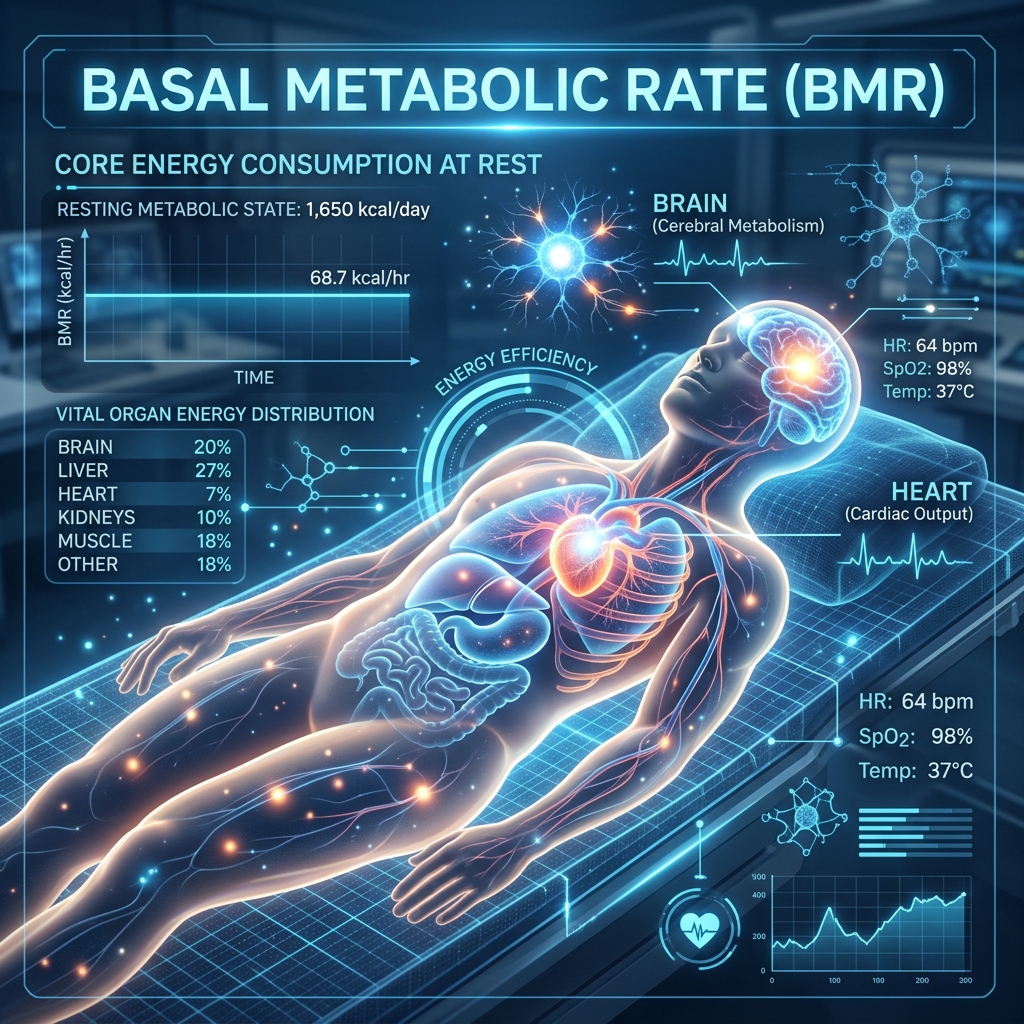
Even when you are lying completely still in bed, your body is working hard. Pumping blood, breathing, regulating temperature, and regenerating cells all require energy. This baseline energy demand is called your Basal Metabolic Rate (BMR).
What is Basal Metabolic Rate (BMR)?
BMR is the absolute minimum number of calories your body needs to survive in a resting, post-absorptive state. Knowing your BMR is the foundation of any structured diet program because it represents your metabolic floor. You can calculate your baseline BMR using our BMR Calculator.
The Science of BMR Equations
Metabolic researchers have developed several formulas over the last century to estimate resting metabolism without expensive clinical chambers:
- Mifflin-St Jeor: The current clinical standard recommended by the Academy of Nutrition and Dietetics. It estimates BMR within 10% of reality for over 80% of individuals.
- Revised Harris-Benedict: An older model revised in 1984. It is widely used but can slightly overestimate BMR in some populations.
- Katch-McArdle: The most accurate equation for people who know their body fat percentage, as it scales strictly with Lean Body Mass (LBM).
Factors Affecting Your BMR
While genetics play a role, BMR is largely determined by three factors:
- Lean Body Mass (LBM): Muscle tissue is highly active metabolically. The more muscle you carry, the higher your BMR.
- Height and Weight: Taller and heavier frames have more cellular surface area to support, demanding more baseline energy.
- Age and Gender: Metabolic rate naturally drops slightly as we age due to natural muscle loss (sarcopenia). On average, males have higher BMRs due to carrying more absolute muscle mass.
If you want to scale this number into a full plan based on your active lifestyle, check out our TDEE Calculator.