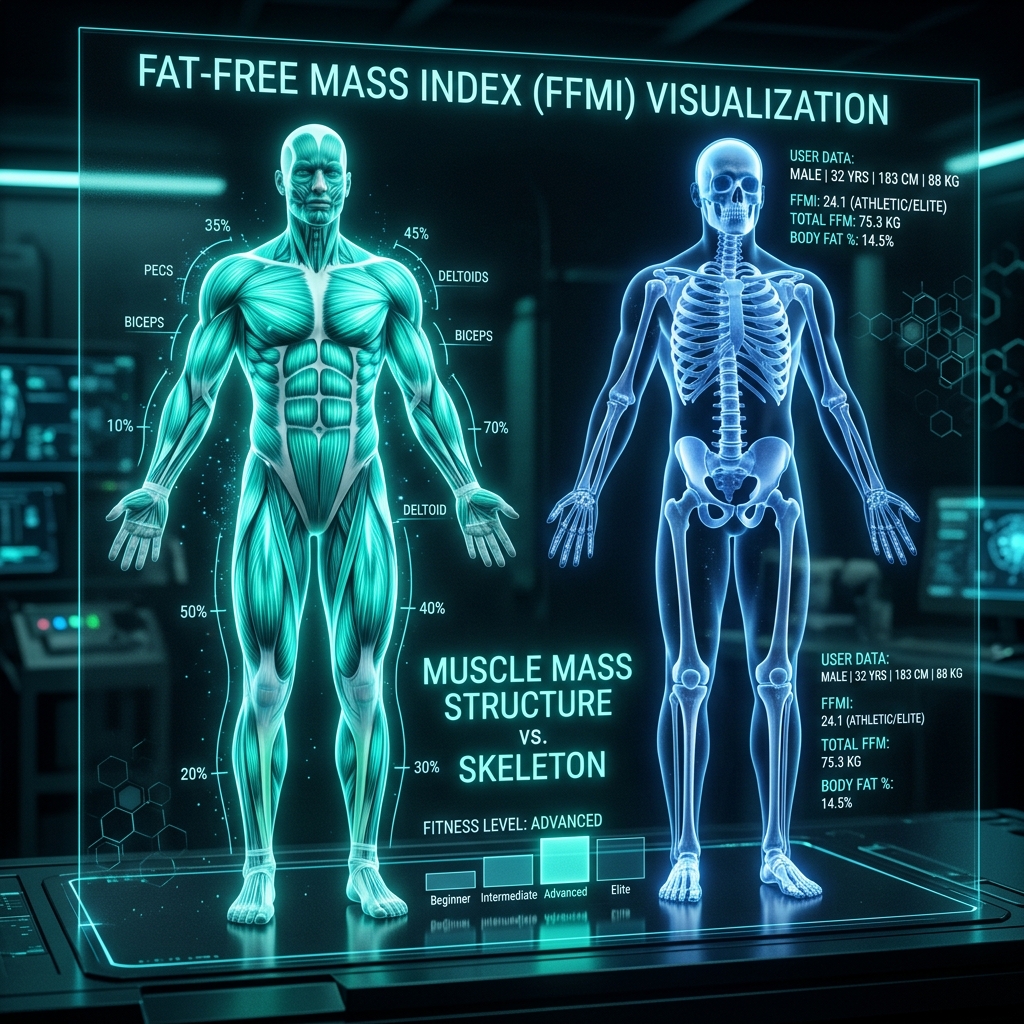
For decades, doctors and health organizations have relied on Body Mass Index (BMI) to categorize whether a person is underweight, normal weight, overweight, or obese. While BMI works reasonably well for sedentary populations, it fails dramatically for lifters and bodybuilders. Enter the Fat-Free Mass Index (FFMI).
The Flaws of BMI
BMI is a simple ratio of weight to height squared (kg/m²). It does not differentiate between fat mass and muscle mass. A 5'10" bodybuilder weighing 205 lbs at a lean 8% body fat will have a BMI of 29.4, classifying them as nearly "obese," despite having low risk factors for metabolic disease. If you want to check your standard index, you can view our BMI Calculator.
What is FFMI?
Fat-Free Mass Index (FFMI) is a formula that evaluates your muscle mass relative to your height. Unlike BMI, it accounts for body fat percentage, isolating your lean mass (muscles, bones, water, and organs) to give an index of muscularity. You can check your lean mass composition using the Lean Body Mass Calculator.
The standard formula for FFMI is:
FFM (Fat-Free Mass) = Weight (kg) * (1 - Body Fat% / 100)
FFMI = FFM (kg) / Height (m)²
A normalized version is also calculated to adjust for taller individuals, who naturally carry more absolute weight. You can calculate your exact score in seconds using our FFMI Calculator.
How to Interpret Your FFMI Score
Research on drug-free lifters and historical bodybuilders has established the following categories for male FFMI:
- 16–17: Below average muscle mass
- 18–19: Average muscle mass (untrained)
- 20–21: Above average (trained)
- 22–23: Highly muscular (years of structured training)
- 24–25: Natural genetic limit range (rarely achieved without exceptional genetics)
- 25+: Typically indicates the use of anabolic steroids or other enhancing compounds
Why Track It?
Tracking your FFMI allows you to measure real progress. Scale weight can fluctuate due to fat gains, water retention, or muscle growth. By combining body fat tracking with FFMI, you can see if your hard work in the gym is actually building new lean muscle tissue over time, rather than just moving the scale needle.